
Welcome to the digital era! The buzzword of the moment is "digital twin," a transformative concept reshaping various industries. A digital twin is essentially a virtual replica of real-world entities—be they objects, processes, or systems—captured digitally. This goes beyond mere visual representation; it's a dynamic simulation tool that enables us to monitor, analyze, and optimize real-world operations.
Digital twin are rapidly becoming indispensable across several sectors, including manufacturing, construction, transportation, and urban planning. In fact, they provide a dynamic way to visualize and manage complex systems. Imagine having a digital counterpart of your factory or city where every component and process is mapped out digitally. More importantly, this model is not static; instead, it is a living, evolving replica that updates in real time. As a result, organizations can predict problems, enhance performance, and facilitate strategic planning more efficiently.
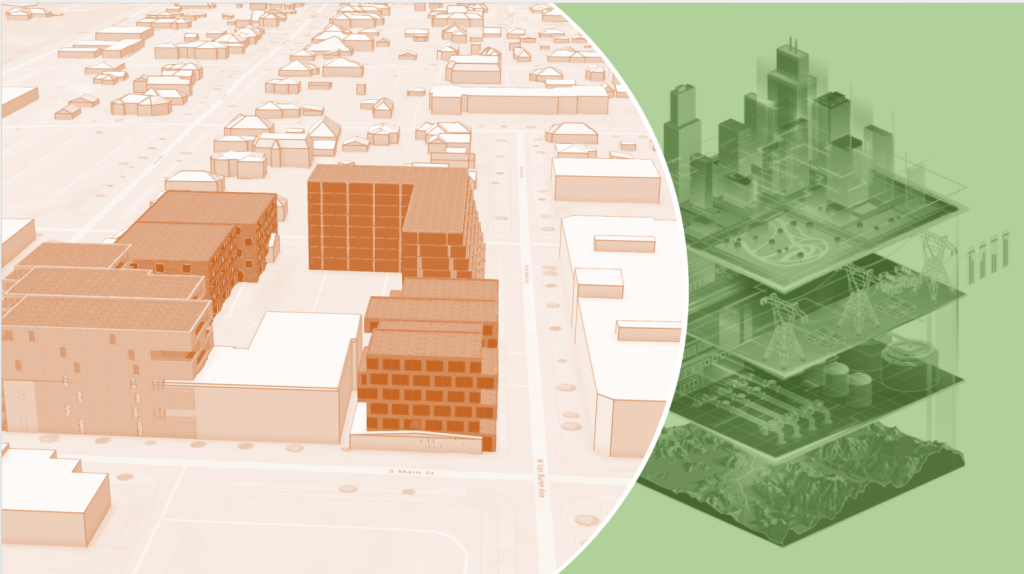
Enhancing Digital Twins with GIS, IoT, and Generative AI
Esri ArcGIS Enterprise is a powerhouse in digital mapping, capable of capturing, storing, and analyzing geographical data. When integrated with digital twin, GIS provides spatial context that enriches the digital replica with geographical insights. This synergy enhances the utility of digital twin, allowing for a more comprehensive understanding and interaction with data.
Adding to this, the integration of IoT sensors plays a crucial role in feeding real-time data into digital twin, making the simulations even more accurate and timely. These sensors collect data from the physical world, which is then reflected in the digital twin, enabling immediate responses to changes and enhancing predictive capabilities.
Generative AI models further amplify the capabilities of digital twin by providing sophisticated data analysis and scenario generation. These AI models can predict outcomes, generate alternative solutions, and optimize processes, aiding significantly in decision-making, especially during complex situations where smart responses are critical.
Why integrate GIS, IoT, AR/VR, and Generative AI with digital twin?
- Spatial Intelligence: GIS’s ability to manage geographical data is crucial for digital twin, especially in large-scale replicas like cities, where it layers information about traffic, demographics, and weather, aiding in more informed decision-making.
- Real-World Simulations: Enhanced by IoT data and Generative AI, digital twin can simulate actual scenarios in real-time, using both historical and live data, enabling predictions and pre-emptive actions—for example, how a building might react during an earthquake.
- Immersive Visualization: Incorporating AR and VR with digital twin allows stakeholders to interact with the simulations in a virtual space, offering an immersive experience that can greatly aid in planning and decision-making processes.
- Smart Decision Support: Generative AI models process vast amounts of data to provide insights and recommend actions, helping to navigate through complex decisions with greater accuracy and efficiency

Advantages of GIS, IoT, AR/VR, and Generative AI Integrated Digital Twin
Integrating GIS, IoT sensors, immersive AR/VR technologies, and Generative AI with digital twin offers numerous benefits:
- Improved Asset Management: Enhanced tracking and maintenance planning through precise location data and real-time condition monitoring.
- Efficient Operations: Real-time data provision to field teams ensures quicker, safer, and more informed responses, augmented by virtual reality tools and AI-driven insights.
- Informed Decision-Making: Geographical data visualization, combined with immersive virtual environments and AI analyses, helps in understanding relationships and forecasting impacts on operations more vividly.
Digital twin are revolutionizing industry operations by duplicating real-world systems into detailed, manipulable models. As a result, these models facilitate profound analysis, ultimately leading to better efficiency, cost reductions, and enhanced strategic decisions. Moreover, various industries—from architecture and engineering to utilities—are already harnessing the power of digital twin. Consequently, they are achieving innovative solutions that drive progress and competitiveness.
Digital Twin and GIS: Shaping Tomorrow
The potential of digital twin integrated with GIS, IoT, AR/VR, and Generative AI is boundless. They streamline processes, minimize risks, and support superior decision-making strategies. As technology progresses, we anticipate even more ground breaking applications across diverse sectors.
Ready to Transform Your Operations?
Join us to explore the power of Digital Twin GIS tailored for your industry! Contact us today for a free consultation and learn how Digital Twin GIS can revolutionize your business.