
The world is rapidly moving toward intelligent, connected, and data-driven infrastructure ecosystems where governments, utilities, industries, and cities can make faster and smarter decisions in real time. At the center of this transformation is the concept of the Digital Twin — a virtual representation of real-world systems that continuously integrates live operational data, simulates outcomes, predicts risks, and provides actionable intelligence. A Digital Twin is no longer just a 3D visualization model; it has evolved into a living intelligent ecosystem powered by Geospatial Intelligence (GIS), BIM, IoT sensors, AI/ML, cloud computing, real-time analytics, and simulation technologies.
Digital Twins are helping organizations move from reactive operations to predictive and autonomous systems. By integrating GIS, 3D models, BIM, IoT devices, enterprise systems, and AI-driven analytics, organizations can create a connected operational environment that delivers real-time situational awareness, infrastructure intelligence, and decision support. From utilities and transportation to smart cities and environmental sustainability, Digital Twins are becoming a critical foundation for digital transformation and operational resilience.
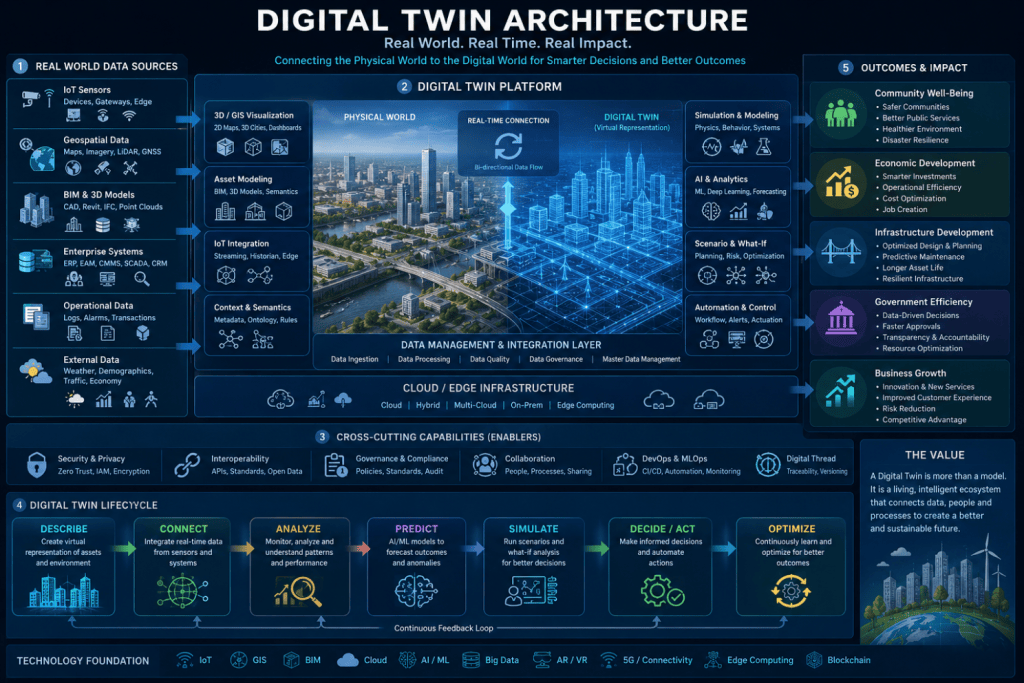
How Digital Twins Work
The maturity journey of a Digital Twin evolves through multiple stages — starting from descriptive visualization to fully autonomous systems. Organizations first create digital representations of assets using GIS, BIM, LiDAR, drones, and 3D mapping. They then integrate live IoT sensors and operational systems to monitor infrastructure performance in real time. With AI and machine learning, Digital Twins become predictive systems capable of forecasting failures, analyzing climate risks, optimizing infrastructure operations, and improving planning decisions. Advanced Digital Twins support scenario-based simulations and autonomous decision-making, creating intelligent ecosystems capable of continuous learning and optimization.

Impact on Communities and Governments
One of the most powerful impacts of Digital Twins is their contribution to community wellbeing and sustainability. Governments can leverage real-time spatial intelligence to improve urban planning, public safety, environmental monitoring, disaster preparedness, transportation management, and citizen services. Digital Twins support air quality monitoring, water resource management, climate resilience initiatives, carbon footprint tracking, and NetZero strategies, helping communities become safer, healthier, and more sustainable. Through simulation and predictive analytics, organizations can proactively respond to floods, wildfires, hurricanes, and infrastructure failures, significantly improving resilience and emergency response capabilities.
For Governments and Enterprises, Digital Twins create a unified operational environment by integrating GIS, BIM, IoT, operational technology, and AI into a common intelligence platform. This improves collaboration, transparency, regulatory compliance, infrastructure prioritization, and resource optimization. Real-time analytics and smart automation also enable faster approvals, smart permitting systems, proactive asset management, and improved citizen engagement, helping governments become more responsive and efficient.
A real-world example of this in action: the City of Uppsala, Sweden, used an Esri GIS-powered 3D Digital Twin to plan a new district of 33,000 housing units for 50,000 new residents by 2050 — helping planners visualize development scenarios, balance sustainability trade-offs, and engage citizens in the planning process. (Source: Esri — "Uppsala Creates a Detailed Digital Twin to Enhance Sustainability")
Similarly, Water Utilities globally are leveraging Digital Twins powered by GIS to predict pipe failures, prioritize asset replacement through data-driven analytics, and reduce the operational impact of aging infrastructure and climate-related disruptions. (Source: Esri — "Digital Twins Bring Value to Water Utilities")
Digital Twin technologies also play a critical role in economic development and infrastructure modernization. Governments and utilities can optimize roads, airports, ports, energy grids, water systems, and telecommunications infrastructure through intelligent operational insights and predictive maintenance strategies. Scenario-based planning helps organizations make smarter investment decisions, reduce operational costs, improve service delivery, and accelerate infrastructure development. This enables long-term economic growth, operational efficiency, and better ROI on critical infrastructure investments.
Digital Twin in Oil & Gas and Energy
In the Oil & Gas industry, Digital Twins are revolutionizing operations across the entire value chain. In upstream, Digital Twins of drilling rigs, wellbores, and subsurface reservoirs enable engineers to simulate production scenarios, optimize drilling parameters, and predict equipment failures before they occur — significantly reducing unplanned downtime and operational risk. In midstream, pipeline Digital Twins integrate IoT sensors, GIS spatial data, and AI analytics to monitor flow rates, detect leaks in real time, and ensure regulatory compliance across thousands of kilometers of infrastructure. In downstream, refinery Digital Twins enable process optimization, energy efficiency improvements, and faster response to operational anomalies — driving safety, cost savings, and operational resilience across the full asset lifecycle.

In Energy Utilities and Infrastructure, Digital Twins are accelerating the transition to smarter, cleaner, and more resilient energy systems. Smart grid Digital Twins integrate real-time demand data, renewable generation outputs, and storage systems to balance energy distribution, reduce transmission losses, and prevent outages. For wind farms and solar installations, Digital Twins simulate environmental conditions and optimize energy output while enabling predictive maintenance of turbines and panels. As organizations pursue NetZero and sustainability goals, Digital Twins provide the data intelligence needed to track carbon emissions, model decarbonization pathways, and optimize energy consumption — enabling utilities to deliver reliable, sustainable, and cost-efficient services to communities and industries.
How IST Is Delivering Digital Twin Solutions
The organizations leading this shift are those that have moved beyond piloting Digital Twin and are now embedding them as core operational infrastructure. Delivering that vision, however, requires more than technology — it demands deep domain expertise, systems integration capability, and a clear understanding of how geospatial intelligence, AI, and real-world operations intersect.
At iSpatial Techno Solutions (IST), we believe Digital Twin are the foundation for the next generation of intelligent infrastructure, sustainable communities, and autonomous operational ecosystems. IST delivers end-to-end Digital Twin solutions by integrating Geospatial Intelligence (GIS), 3D/BIM models, IoT sensor networks, AI/ML analytics, cloud infrastructure, and real-time operational systems into a unified intelligent platform. Our expertise spans Smart Government, Utilities, Energy, Environmental Sustainability, and National Spatial Data Infrastructure (NSDI) initiatives across global markets including the USA, UAE, Netherlands and Bahrain and other regions. IST’s Digital Twin approach enables organizations to transform disconnected data into real-time operational intelligence through live dashboards, predictive analytics, simulation modeling, GeoAI insights, and scenario-based decision support systems. By combining location intelligence with AI-driven automation and real-time simulation systems, IST helps clients improve community wellbeing, operational efficiency, sustainability outcomes, infrastructure resilience, and long-term economic growth.
The Future: GeoAI and Living Digital Twin
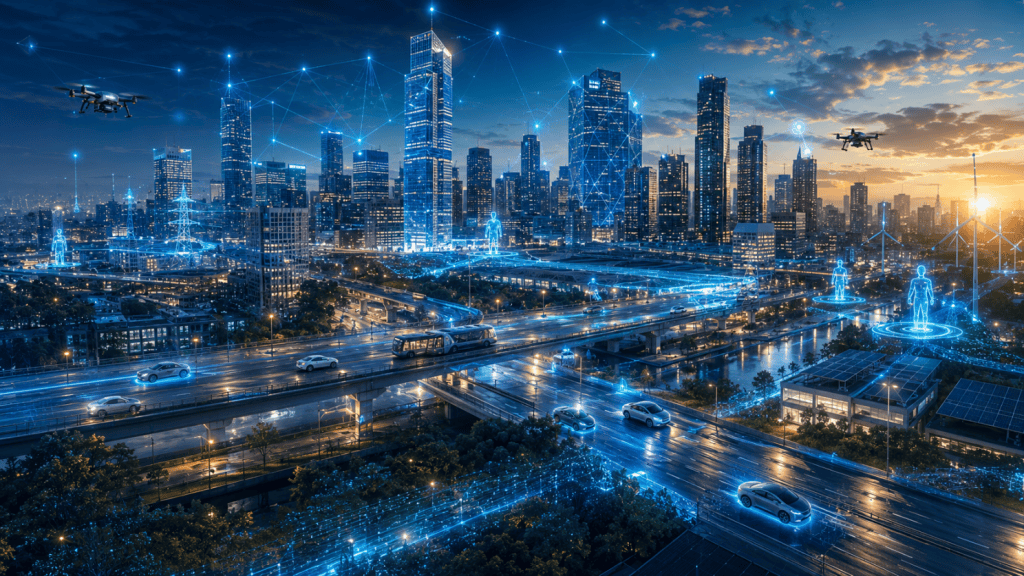
Digital Twin are rapidly evolving beyond visualization systems into intelligent ecosystems capable of supporting autonomous operations, AI-driven decision intelligence, and adaptive infrastructure management. The future will include GeoAI-powered operational ecosystems, AI Agents, self-learning infrastructure systems, and Living Digital Twins that continuously optimize environments in real time. Organizations that embrace Digital Twin strategies today will lead the next generation of digital transformation, sustainability, resilience, and economic innovation.
Key Takeaways
- Digital Twin combines GIS, BIM, IoT, AI, cloud, and simulation technologies into intelligent operational ecosystems.
- Real-time data integration enables predictive analytics, scenario modeling, and autonomous decision-making.
- Digital Twin improves community wellbeing, sustainability, public safety, and infrastructure resilience.
- Governments and businesses can optimize investments, reduce operational costs, and improve efficiency through intelligent infrastructure management.
- GeoAI and Living Digital Twins will shape the future of smart cities, utilities, and connected infrastructure.
Digital Twin is not just about technology — they are about creating smarter, safer, more sustainable, and more connected communities. By combining Geospatial Intelligence, 3D/BIM, IoT, AI, and real-time analytics, organizations can transform data into meaningful insights that improve community wellbeing, accelerate infrastructure development, strengthen government efficiency, and drive long-term economic growth.
Are you exploring Digital Twin strategies for your organization? We'd love to hear how you're approaching intelligent infrastructure — share your thoughts in the comments below. To learn how iSpatial Techno Solutions (IST) can help you build a connected, intelligent operational ecosystem, visit us at www.ispatialtec.com or reach out directly to start the conversation.